


The two largest populations of koalas in Australia are so heavily inbred that they could be wiped out "in an instant" by a single disease, scientists have warned.
A recent study of the tree-dwelling marsupials on Kangaroo Island, which lies off the coast of South Australia, and French Island, off the south-east state of Victoria, revealed that the genetic make up of the koalas was dangerously similar.
More than 20,000 koalas inhabit Kangaroo Island and somewhere between 2000 to 3000 on French Island, but the animals could be quickly wiped out if they were exposed to a disease, the study found.
The inbreeding was the result of a relocation program that began more than a century ago.
Source
|
|
|||||
|---|---|---|---|---|---|---|
|
|
Showing posts with label ecology. Show all posts
Showing posts with label ecology. Show all posts
Monday, June 8, 2009
Australia's koalas at risk from inbreeding
The two largest populations of koalas in Australia are so heavily inbred that they could be wiped out "in an instant" by a single disease, scientists have warned.
A recent study of the tree-dwelling marsupials on Kangaroo Island, which lies off the coast of South Australia, and French Island, off the south-east state of Victoria, revealed that the genetic make up of the koalas was dangerously similar.
More than 20,000 koalas inhabit Kangaroo Island and somewhere between 2000 to 3000 on French Island, but the animals could be quickly wiped out if they were exposed to a disease, the study found.
The inbreeding was the result of a relocation program that began more than a century ago.
Source
A recent study of the tree-dwelling marsupials on Kangaroo Island, which lies off the coast of South Australia, and French Island, off the south-east state of Victoria, revealed that the genetic make up of the koalas was dangerously similar.
More than 20,000 koalas inhabit Kangaroo Island and somewhere between 2000 to 3000 on French Island, but the animals could be quickly wiped out if they were exposed to a disease, the study found.
The inbreeding was the result of a relocation program that began more than a century ago.
Source
Australia's koalas at risk from inbreeding
The two largest populations of koalas in Australia are so heavily inbred that they could be wiped out "in an instant" by a single disease, scientists have warned.
A recent study of the tree-dwelling marsupials on Kangaroo Island, which lies off the coast of South Australia, and French Island, off the south-east state of Victoria, revealed that the genetic make up of the koalas was dangerously similar.
More than 20,000 koalas inhabit Kangaroo Island and somewhere between 2000 to 3000 on French Island, but the animals could be quickly wiped out if they were exposed to a disease, the study found.
The inbreeding was the result of a relocation program that began more than a century ago.
Source
A recent study of the tree-dwelling marsupials on Kangaroo Island, which lies off the coast of South Australia, and French Island, off the south-east state of Victoria, revealed that the genetic make up of the koalas was dangerously similar.
More than 20,000 koalas inhabit Kangaroo Island and somewhere between 2000 to 3000 on French Island, but the animals could be quickly wiped out if they were exposed to a disease, the study found.
The inbreeding was the result of a relocation program that began more than a century ago.
Source
Monday, April 6, 2009
Deer or condors - you pick
Chinese conservationists are in a fix over endangered condors eating large numbers of a protected species of deer in a reserve in the north of the country.
More than 100 young spotted deer have been eaten by the condors so far this spring at the Luanhe River National Nature Reserve in Hebei province, near Beijing,becoming an "unanticipated" part of the food chain.
Nationally, the condor is considered far more endangered than the deer.
"The raptors are growing in number and threatening to catch larger animals, like elk, in the reserve," it quoted wildlife official Zhou Changhong as saying.
The reserve only has 600 or so deer and just 10 elk, the report added.
"An adult condor has a wingspan of more than two metres, and not even wardens can frighten it," Zhou said.
Source
More than 100 young spotted deer have been eaten by the condors so far this spring at the Luanhe River National Nature Reserve in Hebei province, near Beijing,becoming an "unanticipated" part of the food chain.
Nationally, the condor is considered far more endangered than the deer.
"The raptors are growing in number and threatening to catch larger animals, like elk, in the reserve," it quoted wildlife official Zhou Changhong as saying.
The reserve only has 600 or so deer and just 10 elk, the report added.
"An adult condor has a wingspan of more than two metres, and not even wardens can frighten it," Zhou said.
Source
Deer or condors - you pick
Chinese conservationists are in a fix over endangered condors eating large numbers of a protected species of deer in a reserve in the north of the country.
More than 100 young spotted deer have been eaten by the condors so far this spring at the Luanhe River National Nature Reserve in Hebei province, near Beijing,becoming an "unanticipated" part of the food chain.
Nationally, the condor is considered far more endangered than the deer.
"The raptors are growing in number and threatening to catch larger animals, like elk, in the reserve," it quoted wildlife official Zhou Changhong as saying.
The reserve only has 600 or so deer and just 10 elk, the report added.
"An adult condor has a wingspan of more than two metres, and not even wardens can frighten it," Zhou said.
Source
More than 100 young spotted deer have been eaten by the condors so far this spring at the Luanhe River National Nature Reserve in Hebei province, near Beijing,becoming an "unanticipated" part of the food chain.
Nationally, the condor is considered far more endangered than the deer.
"The raptors are growing in number and threatening to catch larger animals, like elk, in the reserve," it quoted wildlife official Zhou Changhong as saying.
The reserve only has 600 or so deer and just 10 elk, the report added.
"An adult condor has a wingspan of more than two metres, and not even wardens can frighten it," Zhou said.
Source
Tuesday, March 31, 2009
Many bird populations in trouble, report says
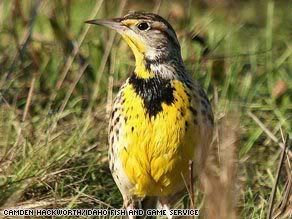 Just as they were when Rachel Carson published 'Silent Spring' nearly 50 years ago, birds today are a bellwether of the health of land, water and ecosystems.
From shorebirds in New England to warblers in Michigan to songbirds in Hawaii, we are seeing disturbing downward population trends that should set off environmental alarm bells.
The declines can be traced to a variety of factors, depending on a bird's particular habitat. But the causes most frequently cited in the report are agriculture, climate change, development and energy, and invasive species.
Source
Many bird populations in trouble, report says
Just as they were when Rachel Carson published 'Silent Spring' nearly 50 years ago, birds today are a bellwether of the health of land, water and ecosystems.From shorebirds in New England to warblers in Michigan to songbirds in Hawaii, we are seeing disturbing downward population trends that should set off environmental alarm bells.
The declines can be traced to a variety of factors, depending on a bird's particular habitat. But the causes most frequently cited in the report are agriculture, climate change, development and energy, and invasive species.
Source
Monday, February 2, 2009
Polar Bears on the Thames
 Eden TV, a new UK-based natural history TV channel has recently begun broadcasting. To celebrate their launch, the network built a 16-foot-high sculpture of a mother polar bear and her cub stranded on an iceberg. Also meant to increase awareness about the plight of the polar bear and their dwindling habitat as a result of climate change, the sculpture was sent to float down the Thames river.
Read more ...
(via Inhabitat)
Polar Bears on the Thames
Eden TV, a new UK-based natural history TV channel has recently begun broadcasting. To celebrate their launch, the network built a 16-foot-high sculpture of a mother polar bear and her cub stranded on an iceberg. Also meant to increase awareness about the plight of the polar bear and their dwindling habitat as a result of climate change, the sculpture was sent to float down the Thames river.Read more ...
(via Inhabitat)
Subscribe to:
Posts (Atom)


